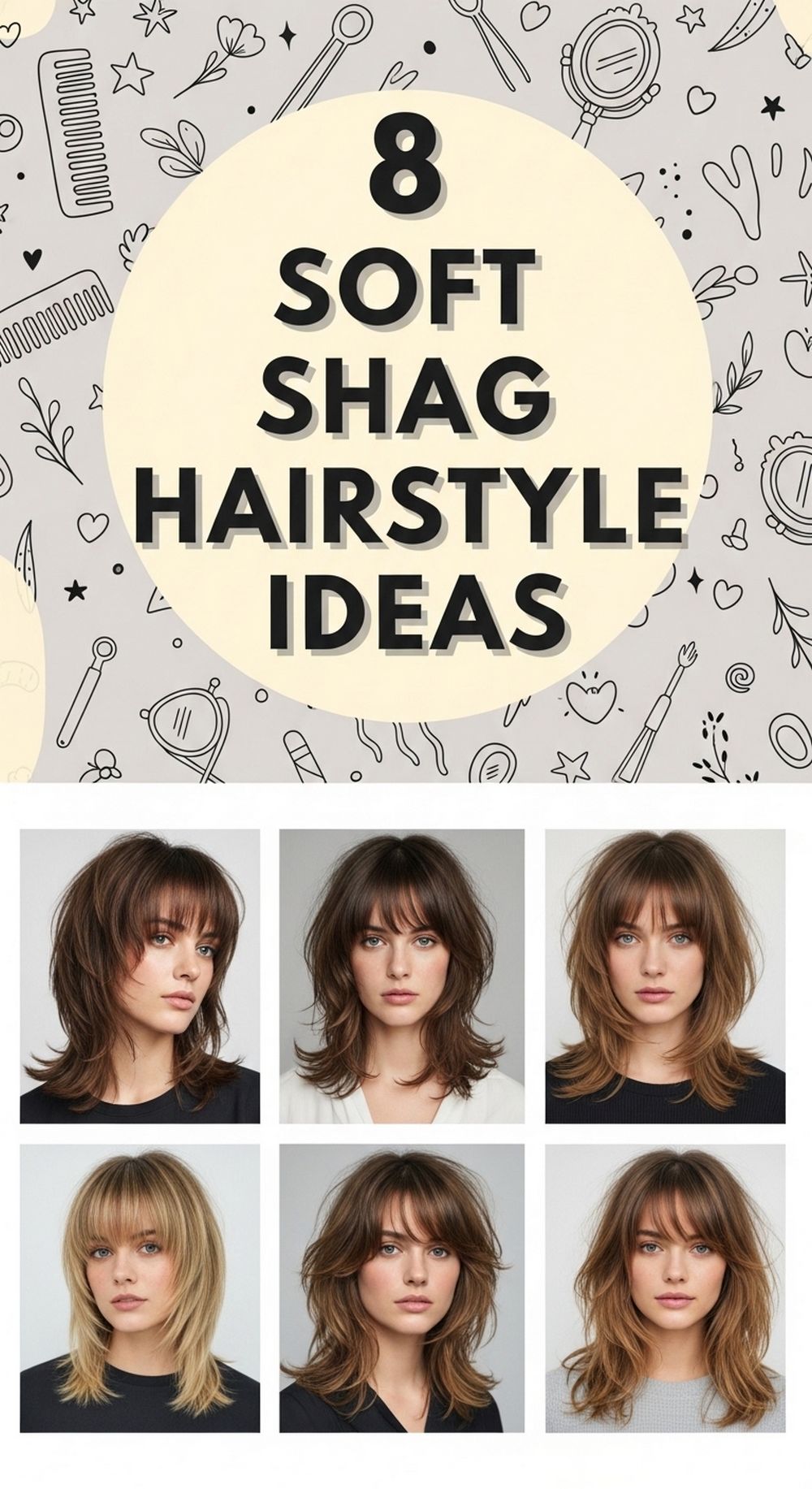
A soft shag is a layered haircut with gentle, feathered texture and movement—without the harsh, heavily razored pieces you might associate with classic 70s or rock-style shags. It has face-framing layers, light shaping through the crown, and airy ends that make your hair look fuller and more “done” even when you don’t try too hard.
The soft shag works on straight, wavy, and curly hair and can be tailored to fine, medium, or thick density. It flatters a lot of face shapes because you can adjust the length of the layers and any fringe to highlight your cheekbones, jawline, or eyes.
Most soft shags are medium-maintenance: you’ll get built-in shape and texture, but the more detailed versions might need a quick blow-dry or wave touch-up. If you prefer low-effort hair, there are softer, air-dry-friendly versions too.
Below are 8 soft shag hairstyle ideas with styling steps, who they suit best, and exactly what to ask your stylist.
Quick List
- Classic Medium Soft Shag Hairstyle
- Long Soft Shag with Face-Framing Layers Hairstyle
- Soft Shag with Curtain Bangs Hairstyle
- Wavy & Curly Soft Shag Hairstyle
- Soft Shag Bob Hairstyle
- Fine Hair Volume Soft Shag Hairstyle
- Low-Maintenance Air-Dry Soft Shag Hairstyle
- Soft Shag with Face-Framing Highlights Hairstyle
Classic Medium Soft Shag Hairstyle

The classic medium soft shag sits between the shoulders and collarbones with light layering throughout and feathered pieces around the face. The crown has a touch of lift, and the ends are soft and wispy rather than blunt, giving your hair that easy, lightly tousled look.
Compared to a sharp layered cut, this shag feels softer and more wearable for everyday. It’s ideal if you want movement and volume without committing to a very edgy or choppy shape.
Pro tip: Ask your stylist for a shoulder-to-collarbone length cut with long, blended layers, light texture at the ends, and soft face-framing pieces that start around the cheekbones.
How To Style
- Start with clean, towel-dried hair.
- Apply a lightweight volumizing mousse at the roots and a smoothing cream or light cream on the mid-lengths.
- Blow-dry using a round brush, lifting at the crown for volume and directing the ends slightly outward for a soft flick.
- Use a curling wand or flat iron (optional) to add a few loose bends through the mid-lengths.
- Shake everything out with your fingers rather than a brush to keep the texture soft.
- Finish with a flexible-hold hairspray or texturizing spray for light, airy hold.
Best For
- Face shapes: Oval, heart, round
- Hair types: Straight to wavy, fine to medium density
Tools & Products
- Blow-dryer
- Medium round brush
- Curling wand or flat iron (optional)
- Volumizing mousse
- Lightweight smoothing cream
- Flexible-hold hairspray or texturizing spray
Styling Time & Difficulty
- Approx. styling time: 15–20 minutes
- Difficulty: Easy to Medium
Where This Hairstyle Works Best
- Everyday wear
- Office or school
- Casual dates and brunches
Maintenance Tips
- Trim every 8–10 weeks to keep layers from looking ragged.
- Use a light leave-in conditioner on the ends to prevent dryness.
- Refresh on second-day hair with dry shampoo at the roots and a light texturizing spray through the lengths.
- Avoid over-thinning; ask your stylist to maintain fullness at the ends.
Long Soft Shag with Face-Framing Layers Hairstyle

This soft shag keeps the length long—past the shoulders or to the chest—but adds layered movement through the mid-lengths and around the face. The face-framing pieces are the star, curving around your cheekbones and jawline while the back remains flowy and soft.
Compared to very layered long cuts, this one feels lighter and more modern and won’t leave your ends looking too thin. It’s great if you love long hair but want it to move and style more easily.
Pro tip: Ask your stylist for long, blended layers with extra attention to shaping around the face, starting near the lips or chin and tapering into your length.
How To Style
- Start with clean, towel-dried hair.
- Apply a light leave-in conditioner and a volumizing or thickening spray through the mid-lengths.
- Blow-dry using a round brush, focusing on turning the face-framing pieces slightly away from the face.
- Use a large-barrel curling iron to add soft, loose waves mainly through the mid-lengths, leaving ends more relaxed.
- Comb through with your fingers to separate and soften.
- Finish with a light shine spray or flexible-hold hairspray.
Best For
- Face shapes: Round, square, heart, oval
- Hair types: Straight to wavy, medium to thick density
Tools & Products
- Blow-dryer
- Round brush
- Large-barrel curling iron
- Leave-in conditioner
- Volumizing or thickening spray
- Shine spray or flexible-hold hairspray
Styling Time & Difficulty
- Approx. styling time: 20 minutes
- Difficulty: Medium
Where This Hairstyle Works Best
- Day-to-night looks
- Dates and events
- Everyday wear for long-hair lovers
Maintenance Tips
- Trim every 10–12 weeks to keep ends healthy.
- Use a hydrating mask weekly to prevent dry, split ends.
- Refresh just the face-framing pieces on busy days—they carry the style.
- Avoid heavy oils at the roots; keep moisture focused on mid-lengths and ends.
Soft Shag with Curtain Bangs Hairstyle

This version pairs a soft shag haircut with curtain bangs that part in the middle and sweep out to the sides. The bangs blend into the top layers, creating a cohesive, face-framing shape that feels very current and flattering.
Compared to a soft shag without bangs, this style gives more focus around the eyes and cheekbones and can soften a larger forehead or strong features. It’s a good choice if you want a “styled” look even on low-effort days.
Pro tip: Ask your stylist for a soft shag with long curtain bangs that start around your cheekbones, slightly shorter in the center and longer at the edges, blending into the layers.
How To Style
- Start with clean, towel-dried hair.
- Apply a lightweight mousse at the roots and a smoothing cream through the mid-lengths and bangs.
- Blow-dry your curtain bangs first using a small round brush—pull them forward, then flick them back and to the sides to create the curtain shape.
- Blow-dry the rest of your hair with a round brush or let it air-dry partially, then finish with a diffuser or dryer for volume at the crown.
- Add a few soft bends with a curling iron through the lengths if you want extra movement.
- Finish with a flexible-hold hairspray focused lightly at the fringe.
Best For
- Face shapes: Round, oval, long, heart
- Hair types: Straight to wavy, fine to medium density
Tools & Products
- Blow-dryer
- Small and medium round brushes
- Curling iron or wand (optional)
- Lightweight mousse
- Smoothing cream
- Flexible-hold hairspray
Styling Time & Difficulty
- Approx. styling time: 15–20 minutes
- Difficulty: Medium (bangs need a bit of practice)
Where This Hairstyle Works Best
- Everyday wear with a stylish twist
- Social events, dates, and photos
- Office or creative work environments
Maintenance Tips
- Trim curtain bangs every 5–7 weeks to maintain the shape around your eyes.
- Use dry shampoo at the roots of your bangs between washes to manage oil.
- Blow-dry your fringe after every wash, even if you air-dry the rest.
- Avoid cutting your own bangs too short; small changes make a big difference.
Wavy & Curly Soft Shag Hairstyle

This soft shag is tailored for naturally wavy or curly hair, with layers that lighten the shape, encourage curl pattern, and prevent the dreaded triangle (heavy at the bottom, flat on top). The overall look is bouncy and airy, not overly thinned or choppy.
Compared to curl cuts with no layers, this version gives more volume at the crown and better shape around the face, while still allowing curls to clump and define nicely.
Pro tip: Ask your stylist (ideally curl-experienced) for a soft shag on dry or lightly dried curls, with long, rounded layers, crown shaping, and no harsh razoring at the ends.
How To Style
- Start with freshly washed, well-conditioned hair.
- Apply a curl cream or leave-in conditioner, then a light curl gel or foam for hold, working in sections.
- Use the praying-hands method to smooth product on, then scrunch upwards to define curl pattern.
- Either air-dry without touching too much or diffuse with low heat and low airflow.
- Once fully dry, scrunch out any cast if you used gel and gently shake out the roots for volume.
- Finish with a light oil or serum on the ends if needed.
Best For
- Face shapes: Oval, heart, round
- Hair types: Wavy to curly, medium to thick density
Tools & Products
- Wide-tooth comb (for detangling in the shower)
- Microfiber towel or cotton T-shirt
- Curl cream or leave-in
- Curl gel, foam, or mousse
- Diffuser attachment (optional)
- Lightweight oil or serum
Styling Time & Difficulty
- Approx. styling time: 20+ minutes (including drying)
- Difficulty: Medium
Where This Hairstyle Works Best
- Everyday natural-texture styles
- Dates, events, and parties
- Settings where you want bouncy, defined hair
Maintenance Tips
- Trim every 10–12 weeks to maintain shape and curl health.
- Sleep with hair in a pineapple or loose high bun on a silk pillowcase or in a silk bonnet.
- Refresh curls on non-wash days with water + leave-in spray and a bit more curl product.
- Avoid brushing dry curls; detangle only when wet with conditioner.
Soft Shag Bob Hairstyle

The soft shag bob is a shorter take, sitting somewhere between the chin and just above the shoulders. It has layered, airy ends and a bit of crown volume, giving bob lovers more movement and personality than a solid one-length cut.
Compared to a classic bob, this version feels more casual and tousled, but still clean enough for professional environments. It’s ideal if you like shorter hair that doesn’t feel stiff or “helmet-like.”
Pro tip: Ask your stylist for a bob-length cut with soft, blended layers through the top and around the face, avoiding heavy stacking at the back.
How To Style
- Start with clean, towel-dried hair.
- Apply a volumizing spray or mousse at the roots and a light cream or milk on the ends.
- Blow-dry using a round brush or paddle brush, lifting at the roots and bending the ends slightly under or out depending on your preference.
- Optionally, add a few loose waves with a small curling iron for extra texture.
- Shake out the style with your fingers for a relaxed finish.
- Finish with a light texturizing mist for separation.
Best For
- Face shapes: Oval, heart, square
- Hair types: Straight to wavy, fine to medium density
Tools & Products
- Blow-dryer
- Round or paddle brush
- Volumizing spray or mousse
- Light styling cream
- Small curling iron (optional)
- Texturizing mist
Styling Time & Difficulty
- Approx. styling time: 10–15 minutes
- Difficulty: Easy
Where This Hairstyle Works Best
- Office or school
- Everyday low-key styling
- Brunches, errands, and day-to-day life
Maintenance Tips
- Trim every 6–8 weeks to keep bob length and shape.
- Use a lightweight conditioner so the layers don’t collapse.
- Refresh the top layers on second-day hair with a spritz of water and round-brush blow-dry just at the crown.
- Avoid over-texturizing; too much can make short ends look thin.
Fine Hair Volume Soft Shag Hairstyle

This soft shag is designed specifically for fine hair that tends to fall flat. The layers are strategic—enough to give body and lift, but not so many that the ends look thin. The result is hair that feels fuller, with built-in shape even when you don’t style much.
Compared to more heavily layered shags, this version is softer and more controlled, making it easier to manage if your hair is naturally lightweight.
Pro tip: Ask your stylist for soft, long layers with gentle crown shaping and minimal thinning at the ends—explain that you want volume but still need the perimeter to look full.
How To Style
- Start with freshly washed hair using a volumizing shampoo and conditioner.
- Apply a volumizing mousse or foam from roots through mid-lengths.
- Blow-dry with your head upside down or with a round brush lifting the roots.
- Once dry, use a small flat iron or curling iron to add a few subtle bends at mid-lengths.
- Shake out with your fingers, avoiding heavy brushing.
- Finish with a lightweight dry texture spray at the roots and mid-lengths.
Best For
- Face shapes: Any (focus is on hair type)
- Hair types: Fine, straight to slightly wavy
Tools & Products
- Blow-dryer
- Round brush
- Volumizing shampoo and conditioner
- Volumizing mousse or foam
- Small flat iron or curling iron
- Lightweight dry texture spray
Styling Time & Difficulty
- Approx. styling time: 10–15 minutes
- Difficulty: Easy
Where This Hairstyle Works Best
- Everyday wear for fine hair
- Work, school, and casual outings
- Situations where you want hair to look thicker without extensions
Maintenance Tips
- Avoid heavy oils and thick creams that weigh fine hair down.
- Use dry shampoo on second-day hair to maintain root lift.
- Get regular micro-trims every 8–10 weeks to keep ends healthy.
- Ask your stylist to reassess your layers each visit so they don’t become too short for your density.
Low-Maintenance Air-Dry Soft Shag Hairstyle

This soft shag is cut to work with your natural texture so you can mostly air-dry and still look styled. Layers are placed to encourage your natural bend or wave, and the ends are softened so the shape grows out nicely.
Compared to more blowout-focused shags, this style is the best choice if you don’t want to rely on hot tools daily. It still looks intentional, but it’s built around your real, everyday styling habits.
Pro tip: Tell your stylist honestly how you usually wear your hair (e.g., almost always air-dried) and ask for a soft shag tailored to your natural texture and part line.
How To Style
- Start with clean, towel-dried hair; gently squeeze water out with a microfiber towel or T-shirt.
- Apply a light air-dry cream or curl cream, focusing on mid-lengths and ends.
- Comb through with a wide-tooth comb and then scrunch or twist sections lightly to encourage your natural pattern.
- Let hair air-dry completely without touching too much.
- Once dry, shake out the roots with your fingers to add some lift.
- Add a small amount of texture spray or serum only where needed.
Best For
- Face shapes: Oval, round, heart
- Hair types: Straight to wavy, low to medium density, low-maintenance lifestyles
Tools & Products
- Microfiber towel or T-shirt
- Wide-tooth comb
- Air-dry cream or light curl cream
- Lightweight serum or texture spray
Styling Time & Difficulty
- Approx. styling time: 5–10 minutes active, then air-dry
- Difficulty: Easy
Where This Hairstyle Works Best
- Busy mornings
- Work-from-home days and casual environments
- Travel and holidays
Maintenance Tips
- Ask for trims every 10–12 weeks; this cut grows out softly.
- Avoid heavy leave-ins that can weigh hair down when air-drying.
- On day two, refresh with a water + leave-in spray and a quick scrunch.
- Sleep on a silk pillowcase to limit frizz and preserve natural texture.
Soft Shag with Face-Framing Highlights Hairstyle

This soft shag keeps the layering gentle but adds brightness around the face with subtle highlights or a soft “money piece.” The color brings out the shape of the shag, making the layers and texture more noticeable without needing heavy styling.
Compared to a one-tone shag, this one looks more dimensional and camera-ready, especially when you wear your hair down with light waves or bends.
Pro tip: Ask your stylist for a soft shag cut plus fine, face-framing highlights 1–2 shades lighter than your base around the front, with subtle blending through the mid-lengths.
How To Style
- Start with clean, towel-dried hair.
- Apply a color-safe leave-in conditioner and a light blowout cream from mid-lengths to ends.
- Blow-dry with a round brush, focusing on lifting the front sections away from the face to show off the highlights.
- Use a curling iron or flat iron to create soft, loose bends, especially around the highlighted front pieces.
- Gently comb through with your fingers to blend the color and texture.
- Finish with a shine spray to enhance the brightness and dimension.
Best For
- Face shapes: All face shapes (highlight placement can be customized)
- Hair types: Straight to wavy, fine to thick density
Tools & Products
- Blow-dryer
- Round brush
- Curling or flat iron
- Color-safe leave-in conditioner
- Light blowout cream
- Shine spray
Styling Time & Difficulty
- Approx. styling time: 15–20 minutes
- Difficulty: Easy to Medium
Where This Hairstyle Works Best
- Everyday wear with a polished twist
- Work, social events, and photos
- When you want your cut and color to both stand out
Maintenance Tips
- Trim every 8–10 weeks and refresh highlights every 8–12 weeks.
- Use sulfate-free, color-safe shampoo and a weekly hydrating mask.
- Add a purple or blue shampoo occasionally if your highlights are blonde and prone to brassiness.
- Protect highlighted hair from heat with a good heat protectant every time you style.
Conclusion
The soft shag hairstyle is one of the easiest ways to get movement, volume, and personality without feeling too edgy or high-maintenance. Because the layers are gentle and blended, you can adapt it to almost any length, hair type, and lifestyle—from long and romantic to short bobbed, or from heat-styled to mostly air-dried.
You can personalize your soft shag with curtain bangs, curly shaping, face-framing highlights, or subtle tweaks to the length and density of the layers. A few centimeters off the length or a small change in fringe placement can completely change how the cut feels on you.
Working with a stylist you trust is key. Bring references, talk honestly about how you usually style your hair, and let them tailor the shape so it flatter your face and works with your natural texture—not against it.
CTA
Pick 1–2 soft shag hairstyle ideas from this list that feel closest to how you want your hair to look day-to-day. Save clear photo references (front, side, and a bit of the back if possible) and bring them to your next salon appointment.
Talk with your stylist about your face shape, hair type, and how much time you realistically spend styling. Together, you can choose the right length, layering, and fringe that make a soft shag feel personalized and easy to live with. With a few small adjustments, you can turn this cut into your go-to, low-effort, high-impact everyday hairstyle.
FAQs
1. What exactly is a soft shag compared to a regular shag?
A soft shag has gentle, blended layers and light texture, rather than very choppy, heavily razored pieces. It still has movement, crown lift, and face-framing shape, but the overall effect is more wearable and less “rocker” or extreme. It’s basically the modern, softer version of the classic shag.
2. Does a soft shag work on all hair types?
Most hair types can wear a soft shag, but the layering and length should be adjusted. Straight and wavy hair can handle more visible layers, while very curly or coarse hair often needs carefully shaped, longer layers to avoid too much frizz or puffiness. Fine hair usually does best with softer, strategic layers so the ends don’t look thin.
3. Is a soft shag hard to style every day?
Not necessarily. Many soft shags are designed to work with your natural texture. Medium styles might need a quick blow-dry or a few bends with a curling iron, but air-dry-focused versions can be very low-maintenance. The key is being honest with your stylist about how much effort you’re willing to put in so they can tailor the cut.
4. How often should I trim a soft shag?
Every 8–12 weeks is a good guideline. If you like a very defined shape and rely on layers for volume, lean closer to 8 weeks. If your shag is longer and softer, you can stretch trims a bit. Regular trims keep the layers intentional and prevent the ends from looking scraggly.
5. Can I grow out a soft shag easily if I change my mind?
Yes, a soft shag generally grows out more gracefully than a very choppy cut. As it grows, it often turns into a layered cut or long layers look. You can ask your stylist to gradually reduce the layering or reshape the ends as your hair gets longer so it stays flattering during the grow-out.
6. What products work best with a soft shag?
Light, flexible products are usually best: volumizing mousse or spray at the roots, light creams or leave-ins on the mid-lengths and ends, and texture sprays or flexible-hold hairspray to define layers. Avoid very heavy oils or thick waxes unless your hair is very coarse—they can weigh down the airy texture.
7. Will a soft shag make my hair look thinner or thicker?
Done right, a soft shag should make your hair look fuller, not thinner. By adding movement at the crown and removing bulk in the right places, it can give the illusion of more volume. Just make sure your stylist doesn’t over-thin your ends, especially if your hair is naturally fine or fragile.