
Softball hairstyles are designed to keep hair secure, comfortable, and out of the face during practice, games, warm-ups, and long tournament days. A good softball hairstyle should stay in place under movement, hold up through sweat and wind, and still feel comfortable under a visor, cap, or helmet. The best styles also help reduce tangling and make quick touch-ups easier between innings.
These hairstyles can work for many face shapes and hair types because the main goal is function with a little personal style. Some players prefer sleek ponytails and buns for a simple feel, while others like braids, bubbles, or protective styles that control the hair even more. Softball hairstyles are especially useful because they need to handle running, sliding, fielding, and repeated helmet use without constantly falling apart.
Most softball hairstyles are low to medium effort once they are secured, but some need a little prep with gel, leave-in conditioner, or braid products. The right style depends on your texture, thickness, and how long you want the look to last. A good softball hairstyle should feel secure enough for game action, but not so tight that it causes headaches or stress on the hairline.
Quick List
- High Braided Ponytail Softball Hairstyle
- Double Dutch Braids Softball Hairstyle
- Low Bubble Braid Softball Hairstyle
- Softball Bun with Headband Hairstyle
- French Braids into Ponytail Softball Hairstyle
- High Puff Softball Hairstyle
- Low Braided Pigtails Softball Hairstyle
- Cornrows into Bun Softball Hairstyle
High Braided Ponytail Softball Hairstyle

The high braided ponytail is one of the best all-around softball hairstyles because it combines the lift of a ponytail with the control of a braid. The top stays secure and off the face, while the braided length helps reduce tangling and too much swinging during running or batting. It feels sporty, practical, and easy to wear.
This version stands out because it works well for both practice and games without needing too much time. It also fits nicely with caps and can often sit comfortably under a helmet as long as the placement is right.
Pro tip: Ask your stylist to keep the layers around the front and crown blended well if you wear braided ponytails often, so fewer small pieces slip loose during games.
How To Style
- Start with clean, dry or slightly damp hair and detangle it fully.
- Apply a lightweight leave-in conditioner if the hair feels dry or rough.
- Use heat protectant only if you plan to smooth the roots with a blow-dryer or flat iron.
- Brush the hair up toward the crown and secure it into a firm ponytail.
- Braid the ponytail all the way down in a simple three-strand braid.
- Fasten the end with a snag-free elastic and tighten the braid gently.
- Finish with light gel or edge control around the front and a mist of anti-frizz spray.
Best For
- Face shapes: Oval, round, heart
- Hair types: Straight to curly, medium to thick
Tools & Products
- Paddle brush or boar bristle brush
- Strong snag-free elastics
- Leave-in conditioner
- Heat protectant
- Light styling gel
- Edge control
- Anti-frizz spray
Styling Time & Difficulty
Approx. styling time: 8–12 minutes
Difficulty: Easy
Where This Hairstyle Works Best
This hairstyle works best for full games, batting practice, field drills, and tournament days when you want secure hair with less tangling.
Maintenance Tips
- Avoid placing the ponytail in the exact same spot every day.
- Use soft but strong elastics to reduce breakage.
- Refresh the hairline with water or leave-in spray after games.
- Loosen the style after play so your scalp can relax.
- Sleep with the hair in a loose braid or down to protect the hairline.
Double Dutch Braids Softball Hairstyle

Double Dutch braids are a favorite for softball because they hold the hair close to the head and stay secure through sprinting, sliding, and repeated helmet use. The two-braid setup spreads tension more evenly than one tight ponytail and usually helps control flyaways better over a long game.
This hairstyle is especially useful for tournament weekends and players who do not want to keep fixing their hair between innings. It feels athletic, dependable, and very game-ready.
Pro tip: Ask your stylist to show you how to keep the braids evenly tensioned and cleanly parted so the style holds well without pulling too hard on the scalp.
How To Style
- Start with detangled hair that is slightly damp or lightly misted with water.
- Apply leave-in conditioner or braid cream for smoother sectioning.
- Use heat protectant only if you need to stretch or lightly smooth the roots first.
- Part the hair straight down the middle from forehead to nape.
- Dutch braid each side by crossing the sections under instead of over.
- Continue down the head and finish the remaining length in braids.
- Secure the ends with elastics and smooth the hairline with light gel if needed.
Best For
- Face shapes: Oval, square, heart
- Hair types: Straight to coily, medium to thick
Tools & Products
- Rat-tail comb
- Spray bottle with water
- Leave-in conditioner or braid cream
- Heat protectant
- Hair elastics
- Light styling gel
- Edge brush
Styling Time & Difficulty
Approx. styling time: 10–20 minutes
Difficulty: Medium
Where This Hairstyle Works Best
This hairstyle works best for doubleheaders, tournament weekends, defensive drills, and players who want a long-lasting style with minimal fixing.
Maintenance Tips
- Sleep in a satin bonnet or on a silk pillowcase to help the braids last.
- Refresh the parting and edges with a light mist of water.
- Clean sweat buildup gently at the scalp after long game days.
- Do not keep the braids in too long if your scalp feels sore.
- Add a little braid cream to dry sections if needed.
Low Bubble Braid Softball Hairstyle

The low bubble braid is a fun but practical softball hairstyle that keeps the hair controlled without needing full braiding skill. It starts with a low ponytail and uses several elastics down the length to create bubble sections. This helps reduce tangling and makes the style feel secure without too much effort.
What makes it different is the softer tension and playful finish. It is a great option for younger players, casual practice, or anyone who wants something quick that still looks sporty and put together.
Pro tip: Ask your stylist to keep long layers blended if you like bubble styles, so shorter pieces stay tucked in more neatly.
How To Style
- Start with brushed, detangled hair and gather it into a low ponytail.
- Apply a smoothing cream or leave-in conditioner through the length.
- Use heat protectant only if you smooth the roots with heat first.
- Secure the base at the nape with a firm elastic.
- Add more elastics every few inches down the ponytail.
- Gently tug each section to create soft rounded bubbles.
- Finish with a little anti-frizz spray and light gel around the front if needed.
Best For
- Face shapes: Oval, long, heart
- Hair types: Straight to wavy, fine to medium
Tools & Products
- Brush
- Multiple snag-free elastics
- Leave-in conditioner
- Smoothing cream
- Heat protectant
- Light gel
- Anti-frizz spray
Styling Time & Difficulty
Approx. styling time: 5–10 minutes
Difficulty: Easy
Where This Hairstyle Works Best
This hairstyle works best for practice days, rec league games, warm-weather play, and players who want a cute but controlled style.
Maintenance Tips
- Use snag-free elastics so removal is gentler after the game.
- Keep the bubbles evenly spaced for better balance.
- Do not tug too hard if your hair is fragile.
- Refresh the nape and crown with water after sweating.
- Take the style out carefully to avoid breakage at each elastic point.
Softball Bun with Headband Hairstyle

A softball bun with a headband is one of the simplest ways to keep everything secure and off the face. The bun keeps the length tucked away, while the headband helps control shorter pieces and absorb sweat near the hairline. It feels neat, compact, and comfortable for active play.
This hairstyle stands out because it is easy to do fast and works especially well for players with layers or growing bangs. It is also practical for helmet use because the hair stays contained and less likely to tangle.
Pro tip: Ask your stylist to keep face-framing pieces at a manageable length if you wear buns often, so fewer strands slip out during games.
How To Style
- Start with dry or slightly damp hair and detangle it well.
- Apply a little leave-in conditioner or smoothing cream if needed.
- Use heat protectant only if you plan to smooth the roots first.
- Pull the hair into a mid or low ponytail depending on helmet comfort.
- Twist the ponytail into a bun and secure it with an elastic or pins.
- Place a soft athletic headband along the hairline to hold front pieces back.
- Finish with light gel at the sides and a mist of anti-frizz spray.
Best For
- Face shapes: Oval, round, square
- Hair types: Straight to wavy, fine to medium
Tools & Products
- Brush
- Hair elastic
- Bobby pins
- Athletic headband
- Leave-in conditioner or smoothing cream
- Heat protectant
- Anti-frizz spray
Styling Time & Difficulty
Approx. styling time: 5–8 minutes
Difficulty: Easy
Where This Hairstyle Works Best
This hairstyle works best for hot practices, catching drills with lots of gear, and players who want extra control around the face.
Maintenance Tips
- Wash the headband often so sweat and product do not build up.
- Avoid twisting the bun too tightly every day.
- Switch bun placement now and then to reduce tension.
- Re-smooth the nape with a little water after games if needed.
- Take the headband off after play so the hairline can relax.
French Braids into Ponytail Softball Hairstyle

French braids into a ponytail give you strong control at the front with a little more freedom through the back. The braided sections keep the hairline and crown in place, while the ponytail makes the style feel lighter and easier than a full braided look. It is sporty, balanced, and very good for game days.
This hairstyle is different because it handles helmet use well while still looking soft and athletic. It is especially helpful for players whose front sections tend to slip loose during warm-ups or swings.
Pro tip: Ask your stylist to place the braids so they follow your natural parting and hairline, which usually helps the style sit better and feel more comfortable.
How To Style
- Start with slightly damp or misted hair and detangle it fully.
- Apply leave-in conditioner or braid cream through the top sections.
- Use heat protectant only if you need to smooth or stretch the roots first.
- French braid one or two sections from the front toward the crown.
- Gather the rest of the hair with the braid ends into a ponytail.
- Secure the ponytail firmly and smooth flyaways with light gel.
- Finish with anti-frizz spray and a small amount of edge control if needed.
Best For
- Face shapes: Heart, oval, round
- Hair types: Straight to curly, medium to thick
Tools & Products
- Rat-tail comb
- Spray bottle with water
- Leave-in conditioner or braid cream
- Heat protectant
- Hair elastic
- Light gel
- Edge control
Styling Time & Difficulty
Approx. styling time: 10–15 minutes
Difficulty: Medium
Where This Hairstyle Works Best
This hairstyle works best for game days, batting practice, long practices, and players who want better front control without a full braid set.
Maintenance Tips
- Redo only the front braids if the ponytail still looks good.
- Refresh the hairline with water or spray between games.
- Avoid making the braid tension too tight near the temples.
- Use a satin scarf at night if you want the braids to last.
- Loosen the ponytail after play to reduce scalp tension.
High Puff Softball Hairstyle
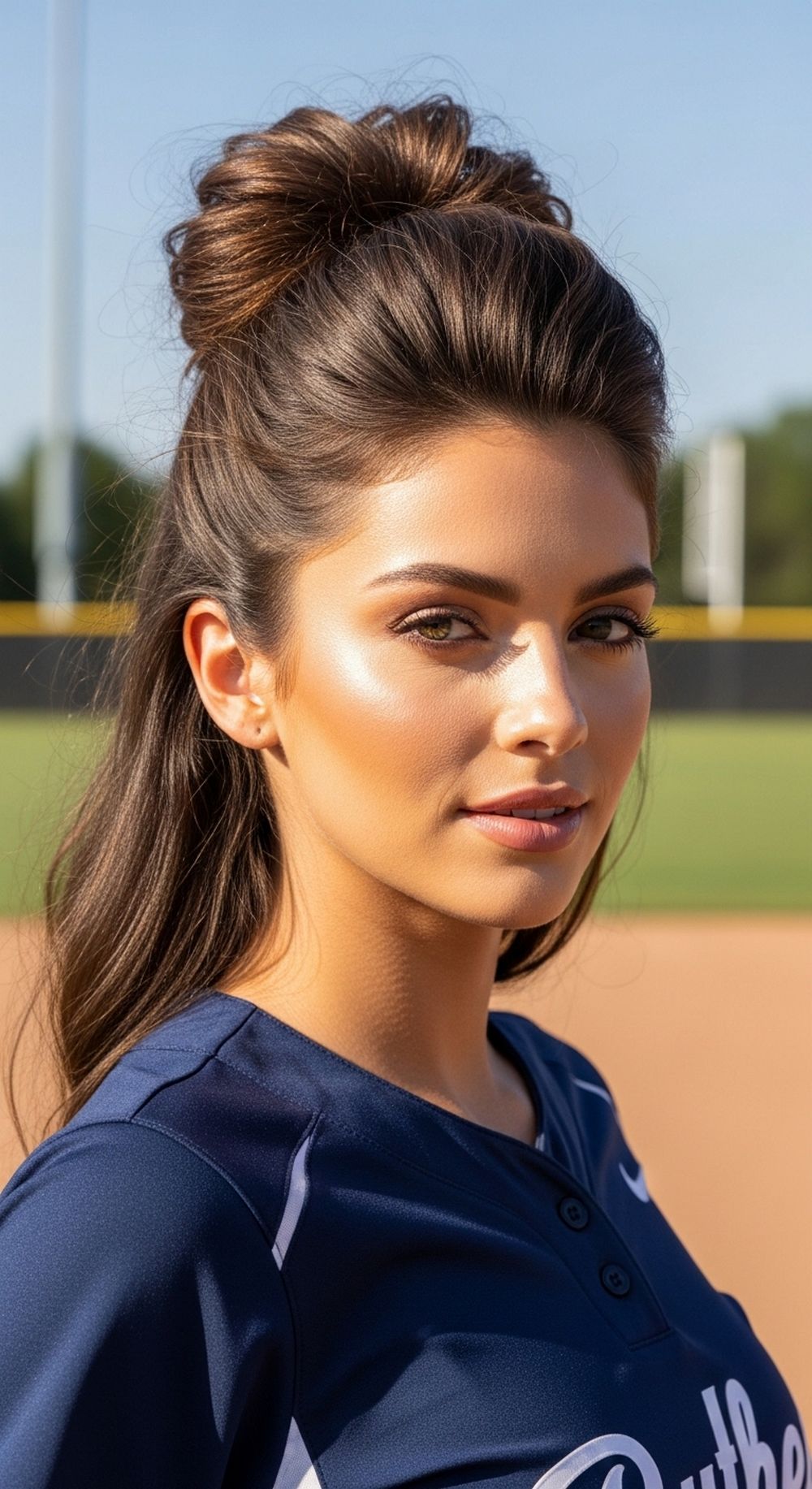
The high puff is a great softball hairstyle for natural hair because it lifts curls up and away from the neck while still showing off their shape and fullness. It feels breathable, sporty, and flattering, especially on hot days or long tournament weekends.
What makes this look special is that it keeps the hair controlled without flattening the natural texture too much. It is a strong choice for players who want something quick, comfortable, and easy to refresh.
Pro tip: Ask your stylist to keep your curls shaped and even so your puff sits full and balanced instead of looking uneven from the front or sides.
How To Style
- Start with moisturized hair and gently stretch or fluff the roots if needed.
- Apply leave-in conditioner or curl cream to keep the hair soft.
- Use heat protectant only if you plan to stretch the roots with heat.
- Gather the hair upward using a puff band, soft elastic, or stretch headband.
- Adjust the placement until the puff sits high and comfortable.
- Smooth the edges and sides with gel or edge control if desired.
- Finish with curl refresher spray or a light water mist for bounce.
Best For
- Face shapes: Round, oval, heart
- Hair types: Curly to coily, fine to thick
Tools & Products
- Wide-tooth comb or pick
- Puff band or stretch headband
- Leave-in conditioner
- Curl cream
- Heat protectant
- Edge control
- Curl refresher spray
Styling Time & Difficulty
Approx. styling time: 5–10 minutes
Difficulty: Easy
Where This Hairstyle Works Best
This hairstyle works best for hot game days, outdoor tournaments, quick practices, and players who want a natural-hair style with easy lift.
Maintenance Tips
- Moisturize regularly so the puff stays soft and defined.
- Avoid pulling the front too tightly to protect the edges.
- Refresh the puff with water or curl spray after games.
- Switch placement from time to time to reduce tension.
- Sleep with a satin bonnet or scarf to help preserve the style.
Low Braided Pigtails Softball Hairstyle

Low braided pigtails are a practical choice for softball because they split the weight of the hair evenly and keep the length controlled on both sides. They are comfortable under many caps and can feel more balanced than one heavy ponytail during long games.
This style stands out because it is simple, secure, and especially useful for younger players or anyone who wants a style that does not swing around too much. It also works well for practice days when you want easy control from start to finish.
Pro tip: Ask your stylist to keep layers soft and blended if you wear pigtail braids often, so the ends stay neater and the braids look fuller.
How To Style
- Start with clean, detangled hair and create a center part.
- Apply a little leave-in conditioner or styling cream for smoothness.
- Use heat protectant only if you plan to smooth the roots first.
- Divide the hair into two low sections near the nape.
- Secure each side lightly, then braid both sections down to the ends.
- Fasten each braid with a soft elastic and adjust the tension if needed.
- Finish with anti-frizz spray and a little gel at the part line.
Best For
- Face shapes: Oval, heart, square
- Hair types: Straight to wavy, fine to medium
Tools & Products
- Rat-tail comb
- Brush
- Leave-in conditioner or styling cream
- Heat protectant
- Hair elastics
- Light gel
- Anti-frizz spray
Styling Time & Difficulty
Approx. styling time: 8–12 minutes
Difficulty: Easy
Where This Hairstyle Works Best
This hairstyle works best for younger players, practice sessions, team warm-ups, and long days when you want even weight and simple control.
Maintenance Tips
- Redo the center part if it starts to shift from helmet use.
- Keep the nape moisturized if you wear low styles often.
- Use soft elastics to avoid pulling at the ends.
- Refresh flyaways with a little water and cream after the game.
- Take the braids out gently to prevent breakage.
Cornrows into Bun Softball Hairstyle
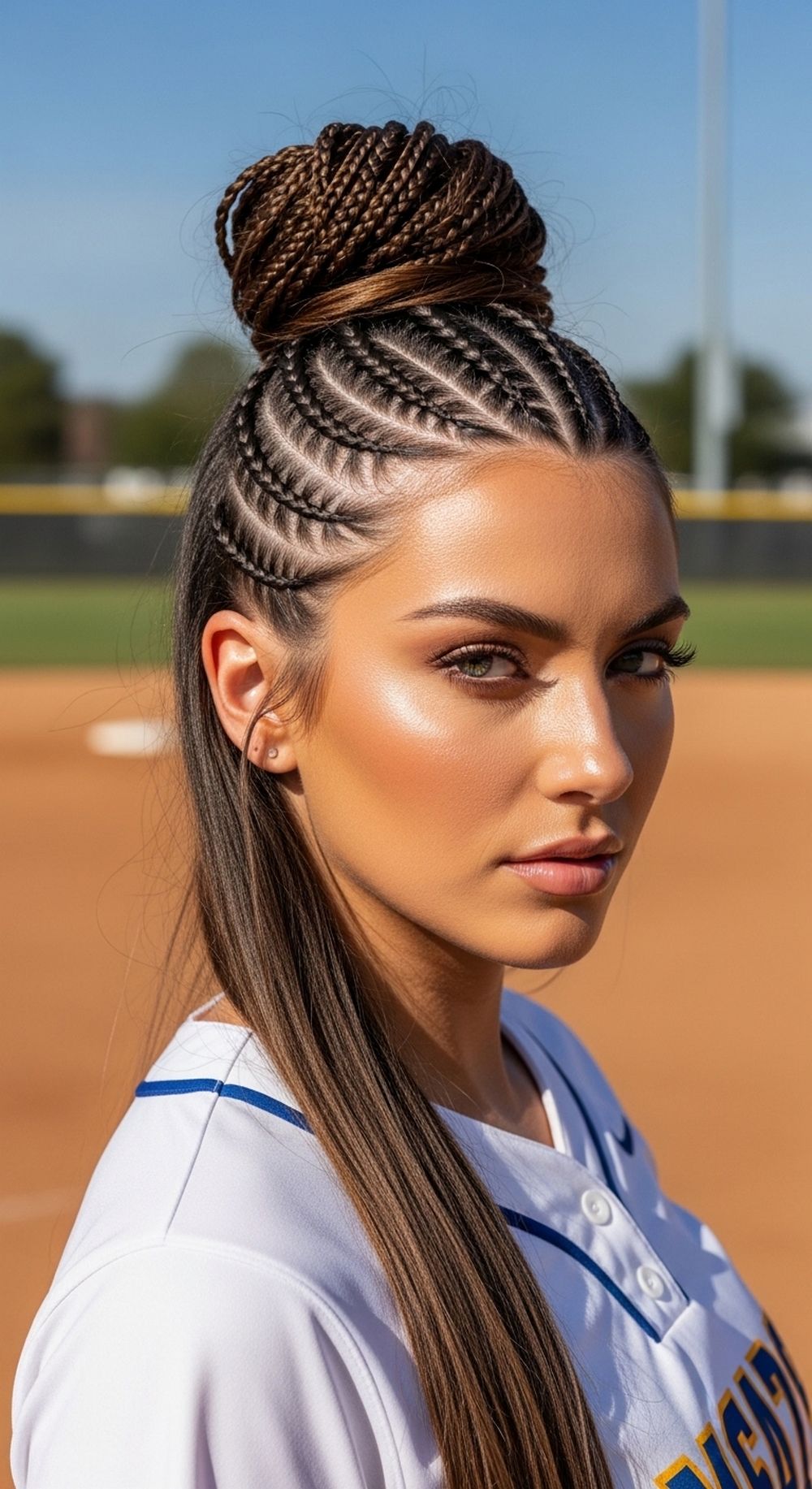
Cornrows into a bun are one of the most secure softball hairstyles for players who want strong control and a style that can last beyond one game. The cornrows keep the top smooth and close to the scalp, while the bun tucks the ends away so they do not swing or tangle.
This hairstyle is different because it stays compact and helmet-friendly while also working as a protective style. It is great for tournament weekends, travel ball schedules, and players who want a longer-lasting option.
Pro tip: Ask your stylist for even parting and a bun placement that feels comfortable with your helmet and normal playing routine.
How To Style
- Start with clean, stretched or detangled hair for easier sectioning.
- Apply leave-in conditioner and a small amount of braid product.
- Use heat protectant if you blow-dry or stretch the hair first.
- Part the hair into even cornrow sections leading toward the bun area.
- Braid each row neatly and gather the ends together.
- Twist or wrap the ends into a bun and secure it well.
- Finish with light scalp oil or scalp mist and edge control if desired.
Best For
- Face shapes: Oval, round, heart
- Hair types: Curly to coily, medium to thick
Tools & Products
- Rat-tail comb
- Leave-in conditioner
- Braid product
- Heat protectant
- Hair elastics
- Edge control
- Light scalp oil or scalp mist
Styling Time & Difficulty
Approx. styling time: 20–35 minutes
Difficulty: Needs some practice
Where This Hairstyle Works Best
This hairstyle works best for tournament weekends, repeated practices, travel games, and players who want a secure protective style that lasts.
Maintenance Tips
- Wrap the style at night to keep the braids neat.
- Clean the scalp gently if sweat builds up after games.
- Moisturize the scalp lightly without soaking the braids.
- Do not keep the style in too long if it starts to feel tight or heavy.
- Protect your edges by avoiding very tight tension near the front.
Conclusion
Softball hairstyles work best when they balance security, comfort, and ease. You want a style that stays put through warm-ups, batting, fielding, and helmet use, but still feels comfortable enough for a long game or full tournament day. That is why ponytails, braids, buns, and protective styles stay so popular for softball players.
The best hairstyle depends on your hair type, how much control you need, and how much time you want to spend getting ready. Some players want the fastest style possible, while others prefer a look that can last through several practices or games. Even small changes in placement, braid pattern, or tension can make a big difference.
It helps to adjust your softball hairstyle over time based on what feels best during real game movement. Working with your texture, protecting your edges, and choosing styles that fit your routine will make your hair feel easier to manage and more comfortable on the field.
CTA
Pick one or two softball hairstyle ideas that fit your hair type, helmet routine, and game-day schedule, then save a few photo references to try. Talk with your stylist about your texture, scalp comfort, and how long you want the style to last. With a few small adjustments, you can make your softball hairstyle feel secure, sporty, and easy to wear every game.
FAQs
1. What is the best hairstyle for softball?
The best hairstyle for softball is one that keeps hair out of your face and stays secure through running, batting, and helmet use. Braids, ponytails, buns, and protective styles are all great choices depending on your hair type and comfort.
2. Do softball hairstyles work for all hair types?
Yes, softball hairstyles can be adjusted for straight, wavy, curly, and coily hair. The main difference is usually the products, prep, and tension needed to keep the style secure and comfortable.
3. Should a softball hairstyle be tight?
It should feel secure, but not painful. A style that is too tight can cause headaches, scalp soreness, and extra stress on the hairline, especially if you wear it often.
4. What hairstyle works best under a softball helmet?
Braids, low buns, and secure ponytails often work well under a helmet because they keep the hair controlled and reduce tangling. The best placement depends on how your helmet fits and how much hair you have.
5. Can I do softball hairstyles without heat?
Yes, many softball hairstyles do not need heat at all. You can braid, puff, twist, or tie the hair using water, leave-in products, and gel instead of hot tools.
6. How do I stop my hair from getting frizzy during games?
Use lightweight anti-frizz products, secure the style well, and avoid touching it too much during play. Headbands, braid products, and light gel can also help with the hairline and top layers.
7. What is a good softball hairstyle for sweaty game days?
Braids, buns, and puffs are usually very good for sweaty days because they keep hair off the neck and face. Styles that control the roots and reduce loose movement tend to hold up best.
8. How can I protect my edges if I wear sporty hairstyles often?
Rotate your hairstyle placement, avoid pulling too tightly, and use soft elastics instead of harsh bands. Keeping the hairline moisturized and taking breaks from tight styles can also help protect your edges.